

Staying active past forty has a way of rewriting the rules. The knee that used to bounce back after a weekend hike now protests for three days. The shoulder that powered through tennis season suddenly clicks during a simple reach for the top shelf. For adults who refuse to slow down, chronic pain treatment in Richmond Hill has become less about chasing quick fixes and more about finding a plan that respects how you actually live, train, and move.
Pain in an active body rarely follows a predictable pattern. You might feel completely fine during a run, then wake up with a hip that refuses to settle. Or you push through a spin class without issue, only to notice your lower back tightening the next afternoon while sitting at your desk. When discomfort shows up hours or even days after the activity that caused it, that delay is usually a sign that surrounding tissues are compensating rather than recovering. Muscles near an older injury start picking up slack they were never meant to carry, joints shift slightly off their natural track, and the nervous system begins amplifying signals it once filtered out without effort.
What a Real Treatment Plan Looks Like
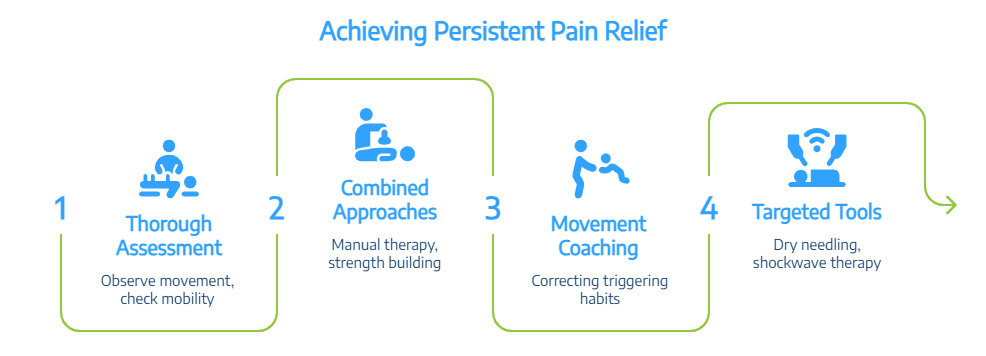
Good physiotherapy for persistent pain requires more than a quick massage and a standard printout of stretches. A thorough assessment starts by observing how you naturally navigate space. Your therapist will watch you squat, reach, and walk before checking your joint mobility and baseline strength. They use those details to shape a strategy that mixes hands-on care with active loading, giving your body both the immediate relief and the physical challenge it takes to recover.
An effective program for active people usually involves a few combined approaches:
- Manual therapy to loosen tight muscles and free up stiff joints
- Specific strength building tailored to the exact demands of your sport or workday
- Movement coaching to correct older habits that keep triggering discomfort
- Targeted tools like dry needling or shockwave therapy to reset stubborn spots
Appointments with us are mapped out carefully so you always leave knowing exactly what improved and what to practice next. You will never receive a cookie-cutter exercise list. Your home routine gets updated every single week, adapting directly to how your body responds between visits.
The Role of Strength, Not Just Rest
Rest was once the standard answer for sore joints, and in the early days after an injury, it can still help. Yet when pain lingers past six weeks, too much rest often creates new problems. Tendons stop tolerating load as well as they should, muscle strength drops off quickly, and the joint can start to feel unreliable even when scans show very little.
What helps most is gradual, well-planned loading. A runner dealing with stubborn Achilles pain usually needs calf raises with enough resistance to challenge the tendon, not endless light band exercises. A pickleball player with an irritated shoulder needs rotator cuff work that builds toward the force and speed of a real serve. That is why treatment for active adults has to be specific. Your rehab should reflect the demands of your routine, not a standard template.
Another part of recovery often gets overlooked: learning how to interpret what your body is telling you. There is a real difference between soreness that comes with rebuilding strength and pain that signals you need to scale back. Once you understand that difference, flare-ups feel less discouraging. They give you useful feedback instead of throwing you off course.
Recovery for active adults works best when it connects to the rest of your week. If you lift three mornings a week, your rehab should plug into that schedule rather than replace it. If your job keeps you at a screen for nine hours, your plan needs to account for the hip flexors that tighten by lunch. Our clinicians build programs around these realities, which is why so many patients finish care stronger than they were before the pain started. Services like sports injury rehab, manual therapy, and custom exercise prescription are designed to work together rather than as isolated appointments.
Pain that has followed you for months does not have to be the new normal, and you don’t have to choose between the activities you love and a body that feels decent the next morning. Book an assessment with us at Premier Care Physiotherapy in Richmond Hill and start mapping out what it takes to move well again.


